

Overview: Teen Weight Training Safety
- Properly supervised and progressively programmed resistance training is safe, effective, and enjoyable for teenagers, according to both the British Journal of Sports Medicine and the American Academy of Pediatrics.
- During training, the most vulnerable part of a teen’s skeleton is their growth plates, making proper technique and load management a must – not a choice.
- Powerlifting, maximal lifts, and bodybuilding are not advised for teenagers who are still growing due to the high risk of serious injury to developing joints and bones.
- The Master Trainer Initiative’s Youth Development Programme provides teens with access to expert-level coaching and structured programming specifically designed for safe adolescent strength development.
- Continue reading to discover exactly which exercises teens should avoid – and the 7 safety rules that every teen lifter must adhere to before touching a barbell.
Weight training is one of the most beneficial activities a teenager can do for their body – but only if it’s done correctly.
Fortunately, there’s no debate. Teens can and should participate in weight training. The question isn’t if teens should lift weights – it’s whether they’re doing it safely, with adequate supervision, intelligent programming, and correct form. When those conditions are met, the benefits are considerable and well-established.
Weight Training Is Safe for Teens, According to Science
Many people still believe that weight training is dangerous for teenagers, but these fears are largely based on myths, not facts. Recent studies have shown that these fears are unfounded. In fact, research consistently shows that resistance training is not only safe for teenagers, but it can also be beneficial when done properly and under supervision.
Confirmation from the British Journal of Sports Medicine
According to a study published in the British Journal of Sports Medicine, resistance training “is a safe and effective method for enhancing physical performance in healthy children and adolescents, provided it is suitably prescribed and supervised.” The emphasis is on the phrase suitably prescribed – aspects such as technique, load, volume, and progression must all be meticulously monitored, especially for those just starting out.
The American Academy of Pediatrics’ Stance on Youth Resistance Training
The American Academy of Pediatrics takes it a step further, declaring that youth resistance training is “safe, effective, and fun.” They believe that teens participating in organized strength training as part of a comprehensive fitness plan is beneficial, as long as the program is suitable for their age and supervised by a competent coach or trainer.
This isn’t an outlandish belief – it’s the accepted medical consensus. Parents and teens can proceed with assurance, knowing the basis is sound.
The Real Reason Behind Most Teen Weight Training Injuries
It’s not the weights that cause the majority of teen weight training injuries – it’s incorrect form, lack of supervision, and progressing too quickly. Injuries typically occur when teens attempt maximal lifts without first mastering the basic movements, or when they increase their training volume without allowing for sufficient recovery time. The most serious risk for teens who are still growing is growth plate injuries, and these can almost always be avoided with the right guidance.
The most avoidable injuries happen in unsupervised training environments, such as home gyms without a coach or copying workouts from social media without any guidance. The answer isn’t to stay away from the gym – it’s to use the gym in the right way.
Why Teenagers Shouldn’t Train Like Adults
It’s important to remember that teenagers aren’t just adults in smaller bodies. They’re still growing and developing, which means their bones, connective tissues, and hormones are different from those of adults. These differences have a direct impact on what is safe and effective for them to do during training.
Understanding Growth Plates and Their Importance
Growth plates (otherwise known as epiphyseal plates) can be found near the ends of long bones, acting as areas where cartilage tissue is developing. These plates are where new bone tissue is created when a teenager is growing. The crucial thing to remember here is that cartilage is not as hard and is more susceptible to injuries than fully developed bone – this means that growth plates are the most vulnerable part of a teenager’s skeleton during training.
Too much weight, bad form, or intense pressure on these areas before they’re fully grown can lead to growth plate fractures or damage. This is why it’s so important to choose the right exercises, use the correct techniques, and manage weight for teen athletes. It’s not about limiting them, it’s about protecting the structures that allow them to continue growing and training for the long haul. For more information on how to improve athletic performance safely, read about youth strength conditioning.
Understanding the Fusion of Growth Plates and Its Impact on Training
Generally, growth plates harden into solid bone and fuse completely between the ages of 17 and 25, depending on the specific bone and the individual. Until then, teenagers are training with a skeleton that is still actively growing. This underscores the importance of avoiding extreme loads, maximal lifts, and unsupervised training, rather than just being a cautious suggestion.
Why Teenagers Should Lift Weights
If done properly, lifting weights can offer a host of benefits for teenagers that go far beyond just getting stronger. Here’s what regular, well-planned weight lifting can do for a teenager’s body and mind:
- Boosted muscle strength and power – teens develop practical strength that transfers into sports, everyday movement, and injury prevention
- Better body composition – resistance training builds lean muscle while promoting healthy fat metabolism
- Healthier bones – weight-bearing exercise stimulates bone density development, reducing future risk of osteoporosis
- Improved cardiovascular health – even resistance training has documented positive effects on cardiac function in adolescents
- Better mental wellbeing – structured training builds self-esteem, discipline, and resilience
- Enhanced sports performance – stronger, more powerful athletes perform better and get injured less
Increased Muscle Strength, Power, and Endurance
Teenagers respond exceptionally well to resistance training stimulus. Even without the high testosterone levels seen in adult males, teens gain meaningful strength through neuromuscular adaptations – meaning their nervous system learns to recruit muscle fibers more efficiently. This is why proper technique pays off so quickly for young lifters. The strength gains in the early stages of training are largely neural, not just muscular, and they build the foundation for safe long-term progression.
Boosting Confidence and Mental Health
There’s something about the gym that gives teenagers a unique confidence boost. Whether they’ve mastered the correct form for a squat, set a new personal record, or just managed to show up on a regular basis — they’re not just building muscles, but also self-belief. Studies have repeatedly found a connection between regular physical activity during the teenage years and lower levels of anxiety and depression.
Many teens find the gym to be one of the few places where their progress can be easily tracked, their hard work is directly rewarded, and they truly feel accomplished.
Heart Health and Lifelong Advantages
Weight training isn’t just for building muscle – it’s great for your heart too. Regular strength training during your teenage years helps maintain healthy blood pressure, improve cholesterol levels, and promote long-term heart health. The habits and physical building blocks you establish during your teenage years can have a snowball effect, influencing your health far into your adult life.
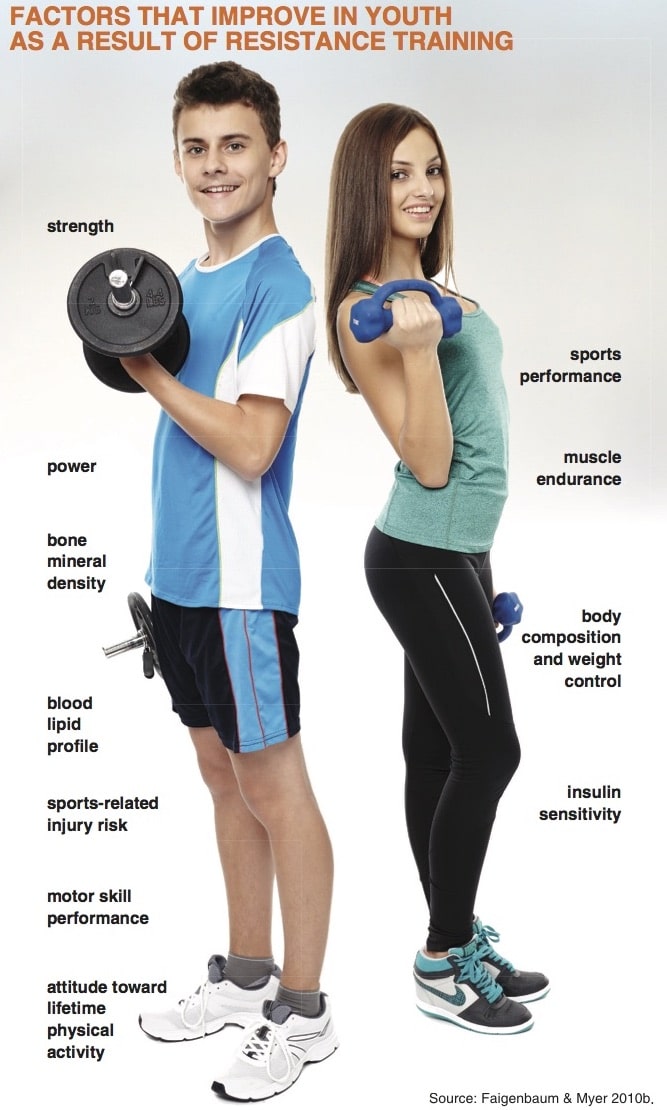
“Resistance Training for Youth: 10 Tips …” from www.ideafit.com and used with no modifications.
7 Safety Guidelines Every Teen Should Adhere to When Weight Training
Safety in teen weight training is simple – but it does require commitment. The rules listed below are not just recommendations or optional additions. They’re the essentials that distinguish between effective training and avoidable injury.
These rules apply across the board, regardless of whether a teenager is working out at a commercial gym, a school facility, or at home. The location may change, but the basics remain the same.
1. Always Start With Light Weights
Before anything else, the weight needs to be appropriate. Starting with light weights isn’t a sign of weakness – it’s how smart athletes build the foundation for long-term progress. For beginners, this often means starting with just bodyweight movements or very light resistance to learn movement patterns before adding any external weight. A teen who masters a bodyweight squat first will be able to do a barbell squat far more safely than one who jumps straight to using weights.
2. Slow and Steady Wins the Race
One of the most important principles of strength training is progressive overload. However, it’s crucial to apply this principle gradually. A good rule of thumb is to increase the weight by no more than 5 to 10 percent at a time, and only when you can lift the current weight with perfect form for all sets. One of the main causes of overuse injuries in teen athletes is trying to lift too much weight too quickly. Remember, slow and steady wins the race.
3. Always Warm Up Before and Cool Down After Each Session
Warming up is an essential part of any exercise regimen. It helps prepare the joints, muscles, and nervous system for the demands of training. For teenagers, this should involve at least 5 to 10 minutes of light aerobic movement, followed by dynamic stretching that targets the muscles being worked on that day. This could include leg swings, hip circles, arm rotations, and bodyweight versions of the main lifts at low intensity.
Don’t neglect the cool-down. It’s just as crucial as the warm-up, yet many people tend to skip it. Doing static stretches after your workout, where you hold each stretch for 20 to 30 seconds, can help reduce muscle soreness. It also aids in increasing flexibility and allows your body to return to a resting state. Both the beginning and the end of your session are important.
4. Work Out Under the Watchful Eye of a Trained Professional
This is an absolute must for those who are new to weight training, particularly teenagers. A skilled coach or personal trainer with experience working with teenagers can spot when form is off, smartly manage progression, and ensure the program is suitable for the individual teenager’s stage of development. Trying to mimic workouts from social media without any guidance is a surefire way to get injured. Having a professional in the room – or at least reviewing the program – can significantly improve safety and results.
5. Maintain Correct Form Throughout Every Repetition
Each repetition done with incorrect form is a repetition that strengthens improper movement habits and places pressure on areas that aren’t built to handle it. Form doesn’t get to deteriorate on the final set because the weight has increased. If the form is lost, the weight is too much – end of story. Teens should exercise with the knowledge that a technically flawless repetition at a lighter weight is always better than a messy repetition at a heavier weight.
6. Master the Basics Before Adding Weight
Before a teen can start lifting heavy weights, they need to master the basics. This means they need to know how to properly perform a squat, deadlift, bench press, and overhead press without any weight. This is not just for safety reasons, but also to make sure they get the most out of their workouts.
Here’s a practical technique-first approach for beginner teen weightlifters:
- Week 1 to 2: Bodyweight only – focus entirely on movement quality, range of motion, and control
- Week 3 to 4: Introduce very light resistance (resistance bands or an empty barbell) – maintain all form standards
- Week 5 onwards: Begin gradual load increases only when movement quality is consistent across all sets and reps
- Ongoing: Record sessions where possible to review technique – what feels right and what looks right are often different things
A teen who spends the first few weeks mastering technique without chasing weight will outperform and outlast peers who loaded up too early. The investment in skill pays compounding returns.
When in doubt about the right form, a professional trainer can be a life-saver. A seasoned coach can spot tiny mistakes in movement mechanics that may go unnoticed by an untrained eye but can increase the risk of injury over time.
7. Don’t Ignore Warning Signs
Teens should be aware of their body’s responses during a workout. If they experience sharp pain, joint discomfort, unusual fatigue, or anything that feels off during a set, they should stop immediately. This is their body’s way of telling them something isn’t right. Both teens and adults should never train through pain. While muscle fatigue is normal, pain in a joint or bone is not. Stopping a set early isn’t a sign of failure, it’s a sign of intelligent training. Ignoring these warning signs is how minor issues can escalate into serious injuries that can put training on hold for weeks or even months.
Want your teenager training with weights safely?
Growth plates and technique matter. Our Youth Athlete Development programme builds strength with proper supervision and age-appropriate loading.
Explore Youth Development →Training Styles and Exercises Teens Should Stay Away From
Every training method isn’t the same, and some are downright unsuitable for teenagers who are still growing. It’s just as important to know what not to do as it is to know what to do.
We’re not trying to prevent teenagers from reaching their full potential in the gym. Our aim is to safeguard their bodies, which are still growing, so that they can exercise regularly, make progress without risking injury, and lay the groundwork for a lifetime of fitness – not just for the next few months.
Why Teens Should Avoid Powerlifting and Maximal Lifts
Powerlifting, especially training that involves trying to lift the maximum weight possible in one rep or close to it, puts extreme pressure and shear forces on the spine, joints, and growth plates. For a teenager whose bones are still actively growing, this kind of stress can seriously risk fracturing the growth plate or causing long-term damage to the joints. The same is true for Olympic weightlifting with heavy weights before the foundational strength and technique are well developed.
It’s not advisable for teenagers who are still growing to engage in bodybuilding-style training, which emphasizes extreme hypertrophy, very high volume, and excessive caloric surplus. The hormonal environment, recovery ability, and nutritional requirements of this type of training are not compatible with adolescent physiology.
Training Style | Safe for Teens? | Reason |
|---|---|---|
Bodyweight resistance training | ✓ Yes | Low joint stress, excellent for building foundational movement |
Light to moderate resistance training | ✓ Yes | Safe with proper technique and supervision |
Resistance band training | ✓ Yes | Low risk, highly effective for beginners |
Powerlifting / 1-rep max attempts | ✗ No | Excessive load on growth plates and joints |
Competitive bodybuilding | ✗ No | Extreme volume and dietary demands unsuitable for adolescents |
Unsupervised heavy Olympic lifting | ✗ No | High technical demand combined with excessive load risk |
The table above isn’t about gatekeeping the gym – it’s about matching the training stimulus to where a teenager’s body actually is in its development. As growth plates fuse and foundational strength is built, the range of appropriate training expands significantly.
The Dangers of Anabolic Steroids and Performance-Enhancing Drugs
Anabolic steroids and performance-enhancing drugs should never be used by teenagers. There is no situation in which their use is justified. In addition to the well-known risks for adults, such as liver damage, cardiovascular problems, and hormonal disruption, teenagers face an additional risk. That is the premature closure of growth plates. This means that if a teenager uses steroids, their skeletal development can be permanently stunted. They may end up shorter than they would have been if they had not used steroids. The pressure to perform or to look a certain way can be intense. However, no short-term benefits are worth the long-term risks.
Finding the Right Support as a Teen Weightlifter
Going to the gym without guidance is like trying to learn a foreign language without a teacher – you might pick up a few things, but you’ll likely develop bad habits that take twice as long to correct later. The right support structure can make the difference between a teen who trains safely, makes steady progress, and actually enjoys it – and one who gets injured, loses motivation, and quits within a few months.
Finding the Right Youth Strength Coach
Just because someone is a personal trainer doesn’t mean they’re the best choice for a teen. A coach or trainer for a teenager should have certain qualifications and characteristics. They should have a recognized strength and conditioning certification, and they should also have proven experience working with teenagers. It’s not enough for them to have experience training adults.
In addition to qualifications, the ideal coach should value form over pride, favor steady improvement over quick gains, and maintain open lines of communication with both the adolescent and their guardians. A competent youth strength coach is also someone the adolescent genuinely likes – because a teenager who doesn’t trust their coach won’t ask questions, won’t raise concerns, and won’t fully benefit from the advice provided. The rapport is just as important as the CV.
How the Master Trainer Initiative’s Youth Development Programme Supports Teen Athletes
Teenagers and parents who are in search of structured and expert-backed guidance can turn to the Master Trainer Initiative’s Youth Development Programme. This program was created with the intention of providing teenagers and adolescents with the expert knowledge, structured programming, and qualified coaching they need to approach weight training safely and effectively – eliminating the guesswork that comes with self-directed training at that age.
What distinguishes a dedicated youth program from a general gym membership is the specificity of the approach. The program is designed around adolescent physiology, rather than being adapted from adult templates. Load progressions are managed intelligently. Technique is prioritized from day one. For any teen serious about building strength safely, working within a program designed for their stage of development is the smartest starting point available.
Teen Opportunities in School and Local Gyms
Schools often offer strength and conditioning classes that are underused. When these classes are led by a qualified PE teacher or strength coach, they offer a supervised, structured environment where teens can learn basic movements. This is a great opportunity for teens because there are very few barriers to entry. For more information on effective youth training, explore how youth strength conditioning improves athletic performance.
Teens who are looking for more than just school sports can usually find a local gym that offers memberships for kids 14 to 16 years old. Most of these gyms require a parent or guardian to be present during workouts. When you’re picking a gym, try to find one that offers special classes for teens, has qualified staff on duty during busy times, and has well-kept equipment that’s suitable for beginners and intermediate weight lifters. It’s a good idea for any teen who’s new to weight training to start out in a class, rather than trying to figure out how to use free weights on their own.
Weight Training for Teens Is Safe – If Done Correctly
The research is conclusive, the medical community agrees, and the benefits are tangible – weight training for teens is safe, it works, and it is truly beneficial for adolescent development. The factors that make it safe are equally obvious: correct form, professional supervision, slow progression, age-appropriate programming, and the common sense to avoid lifting the maximum amount of weight and using performance-enhancing substances while the body is still growing. None of these factors are hard to achieve. They just need purpose, the right direction, and a dedication to doing it right from the beginning.
Commonly Asked Questions
Teen weight training often leads to a lot of inquiries – from parents worried about their child’s safety to teenagers who are excited to begin. The responses below sift through the clutter and provide the information you really need.
These aren’t just unique or rare circumstances. They are the most common questions that people have, and knowing the answers to them can be the difference between feeling confident about teen strength training or being unnecessarily hesitant.
Will Weightlifting Stop Teens from Growing?
False – it’s a myth that weightlifting stunts growth in teens when performed correctly. This is one of the most enduring misconceptions in the fitness world, and recent studies consistently debunk it. The fear comes from the idea that damage to the growth plate could impact bone growth, but injuries to the growth plate in supervised, correctly planned resistance training are incredibly infrequent and almost always avoidable.
Studies have shown that proper weight training can actually help teens develop healthy bone density. The problem isn’t the weights themselves. The problem is when teens lift too much weight, use bad form, or try to lift their max weight without supervision. As long as those things are avoided, there’s no reason to worry about stunted growth.
What is the Appropriate Age for a Teenager to Begin Weight Training?
Children as young as 7 to 8 years old can start structured resistance training if they have the interest and maturity to follow directions, according to guidelines from pediatric health experts. For teenagers in particular, there is no specific minimum age for appropriate resistance training. Far more important than actual age is physical maturity, the ability to consistently follow coaching cues, and the presence of adequate supervision. A motivated, coachable 13-year-old is a better fit for a structured program than a disinterested, unsupervised 17-year-old.
How Often Should Teens Lift Weights?
Two to three weightlifting sessions per week is a good starting point for most teens. This frequency provides enough stimulus for meaningful strength and neuromuscular development while allowing enough recovery time between sessions. This is especially important for teens whose bodies are simultaneously managing growth and training adaptation. As conditioning improves and recovery capacity increases, frequency can be extended to three to four sessions per week for more experienced teen lifters. Always make sure to have at least one full rest day between sessions targeting the same muscle groups.
Do Teens Need to See a Doctor Before Starting a Weight Training Program?
For the majority of healthy teenagers, a doctor’s visit before beginning a weight training program is more of a good idea than a hard and fast rule. However, for teenagers with pre-existing conditions, it is highly recommended, and in some cases, necessary to get medical clearance.
Teens who have uncontrolled high blood pressure, seizure disorders, heart conditions, or any musculoskeletal issues should be given the all-clear by their doctor before starting any structured training programme. This is not about putting up barriers, but about making sure the programme is safe and suitable for that person’s particular health condition. For most teens who have no underlying health issues, the chat with the doctor is short and simple, and the answer is almost always a green light.
What’s a Safe Weight for a Teenage Beginner to Start Lifting?
The truthful answer is: any weight that lets them maintain perfect form for the entire set. That’s the only true gauge that’s important for a beginner. There isn’t a one-size-fits-all starting weight because body weight, experience with movement, age, and individual strength levels can vary greatly among teenagers.
For most teenagers who are just starting out, it’s a good idea to begin with bodyweight exercises. They should become proficient in squats, hip hinges, push-ups, and rows before adding any external weights. When they’re ready to add resistance, it’s usually best to start with resistance bands or an empty barbell. A standard Olympic barbell typically weighs 20kg, but a shorter training bar can weigh as little as 5 to 10kg. These are suitable for most basic compound exercises.
The main idea is this: if the form is compromised at any time during the set, the weight is too heavy. A teenager who can do three sets of ten repetitions with full control, through a full range of motion, with no form compromise – consistently, over several sessions – is ready to consider a small increase in weight. Not before.


